Material Properties: What Bamboo Can and Cannot Do
Bamboo is often called nature’s structural miracle. Yet treating it like ordinary timber or magical green plastic leads to unrealistic expectations. Here is how its biology shapes its physical boundaries.
The Anatomy of a Fast-Growing Grass
Unlike trees such as oak, maple, or walnut, bamboo possesses no secondary cambial growth. It produces no annual growth rings and will not expand in diameter once its shoot emerges from the ground. Its entire structural culm reaches full height (up to 20 metres for Phyllostachys edulis) in less than two months, then spends three to five years lignifying and densifying.
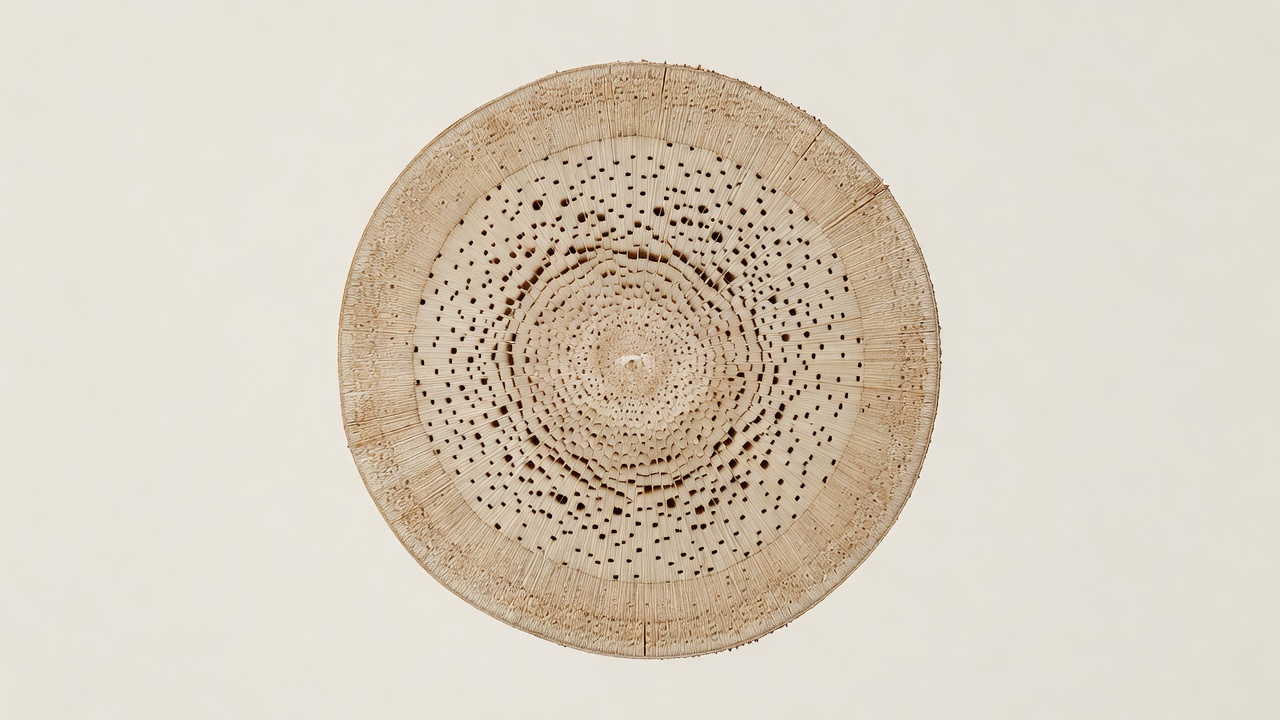
Figure 2.1: Microstructural diagram render: high concentration of cellulose vascular bundles toward outer epidermis, transitioning into parenchymal storage tissue inwardly.
This anatomical gradient means bamboo is not uniform. The outer third of the culm wall boasts exceptional density, high silica content, and a Janka hardness exceeding 1,400 lbf, outperforming standard red oak. The interior inner wall, however, is soft, porous, and prone to rapid fungal rot if not stripped away prior to machining.
Tensile Strength vs. Shear Weakness
Because all cellulose fibrils are aligned strictly parallel with the vertical axis of the stalk, bamboo displays tensile strength comparable to mild structural steel along its grain (up to 300 MPa under lab conditions). However, its cross-grain radial cleavage strength is nearly non-existent. A child can split a fresh, dry five-foot bamboo pole down the middle using a pocket knife.
To transform such split-prone tubes into rigid flat boards for bread boxes, desks, or cutting boards, fabricators must machine narrow rectangular strips, boil them to remove starch, kiln-dry them, and laminate them together using cross-ply orientation or resin bonding.
Natural vs. Carbonised Bamboo
In home goods, you will almost universally encounter two distinct visual tones: light blonde and deep caramel brown.
Natural (Blonde) Bamboo
Strips boiled in hydrogen peroxide to strip natural sugars and prevent beetle infestation. Retains maximum hardness and tensile integrity.
Retains 100% Core HardnessCarbonised (Caramel) Bamboo
Strips pressure-steamed at high temperatures (120°C–140°C). Sugars caramelise into rich amber tones, but heat breaks down cellulose fibres.
Softened by 20% to 30%For cutting boards and flooring, natural blonde bamboo lasts significantly longer against gouging, whereas caramelised bamboo will develop deep knife incisions that harbour moisture.
The Chemistry of Modern Composites
When assessing bamboo wares, remember that glue is a fundamental ingredient. Strand-woven bamboo, commonly promoted for indestructible heavy-wear chopping blocks and outdoor decking, is produced by crushing culms into loose fibrous mats, submerging them into an adhesive bath (frequently urea-formaldehyde or phenol-formaldehyde), and curing them under several thousand tonnes of pressure.
| Processing Type | Bamboo Fraction | Adhesive Type | Degradability |
|---|---|---|---|
| Whole Pole / Split Cane | 100% Raw Culm | None (Mechanical lashings) | 100% Home Compostable |
| Edge-Glued Planks | 88% – 94% Culm | E0 / E1 Aliphatic Resin | Non-compostable core joints |
| Strand-Woven Block | 75% – 82% Fiber | Phenolic / Isocyanate Binder | Landfill or Incineration only |
| Moulded Composite Powder | 30% – 50% Dust | Melamine-Formaldehyde Resin | Thermoset Plastic (Non-recyclable) |
Moisture Absorption and Delamination
Unlike plastics, bamboo is hygroscopic. Its cellular micro-capillaries eagerly absorb atmospheric moisture. When relative humidity fluctuates wildly—or when utensils are washed under boiling tap water and dried in direct sunlight—individual strips expand and contract unevenly. This produces shear stress across the glued joints, causing the dreaded "stepped delamination" familiar to owners of cheap bamboo spoons.
Material Summary: The Realistic Spec
Bamboo is superb for lightweight stationery trays, drawer dividers, bathroom dry-caddies, and well-maintained kitchen cutting surfaces. It is unsuited for boiling soup ladles, underwater soap dishes, and outdoor environments exposed to perpetual rain without chemical biocides.